Live virtual workshop · January 14, 2027
The Aspirational Spirit of MI
Learning from the Work
Without Carrying It All
Some conversations stay with us after the workday ends. We replay what we said, question our judgment, or notice ourselves becoming less open with the next person.
Practice a structured way to reflect on demanding work, identify what needs action, and carry useful learning into your next encounter.
Practice reflection after a difficult day
Complete a guided reflection, rehearse a response, and make a plan for using the process during the following week. You may use a supplied fictional case throughout; sharing a personal experience is optional.
Reflect on how MI spirit shapes your work
Partnership, acceptance, compassion, and empowerment give us a direction for how we want to work. An aspirational approach makes room to examine moments when our responses fall short, while keeping our practice standards in view.
Drawing on The Aspirational Spirit of MI, we will ask: Where was partnership present? When did acceptance or compassion become harder to sustain? How did my response support the other person’s agency?
Functional closure connects those questions to an observable next step: acknowledge a missed opportunity in the next conversation, ask what you missed, or bring a recurring difficulty into supervision. Revisiting what happened after that step helps you notice what you understand differently and how that understanding shows up in practice.
What functional closure means
Functional closure is a practical process for making sense of a professional experience and bringing reflection to a point where you can decide what to do next.
You examine what happened and your response, identify what you learned and what responsibility remains yours, and choose an action or the support you need. Reflection reaches a useful stopping point, with a plan for returning to anything unfinished. The situation may remain difficult; you have a way to proceed.
We will distinguish this from settling too quickly on an explanation or repeatedly replaying a concern without a workable next step.
The closure distinctions draw on Rønnestad and Skovholt’s practitioner-development model. The workshop reflection routine is an AMIGA teaching adaptation.
What you will practice
Make reflection useful
- Separate what happened from your interpretation of it.
- Recognize what a reaction reveals about your values and the aspect of MI spirit that felt strained.
- Identify an appropriate next response, including any repair, consultation, or support still needed.
- Bring reflection to a useful stopping point while preserving necessary follow-through.
Take the practice into your week
You receive a personal reflection worksheet, fictional practice case, five-workday practice log, and selected research references.
During the workshop, you will complete a guided reflection and rehearse a future response with a partner. Leave with a clear next step and a routine to try during the following working week. Your practice log helps you revisit what you tried, what you learned, and what further support is needed.
Personal reflections remain private. Only the action-plan exit ticket and learning check are collected for completion.
Reflection, workload, and practitioner support
Burnout and compassion fatigue matter because the demands of helping can affect how practitioners experience their work and their capacity to stay engaged. Functional closure offers a way to examine that experience, distinguish useful reflection from repeatedly replaying the same concern, and identify what needs action or support.
This evidence-informed workshop applies ideas from reflective learning and recovery research. It is not an established treatment or a guarantee against burnout or compassion fatigue. The practice belongs alongside manageable workloads, protected reflection time, effective supervision, and organizational action on the conditions affecting staff.
Two hours built around practice
| Time | Experience |
|---|---|
| 0–25 minutes | Choose a work moment and explore aspirational MI spirit. |
| 25–40 minutes | Compare premature, inadequate, and functional closure through a demonstration. |
| 40–55 minutes | Complete a guided private reflection. |
| 55–60 minutes | Take a five-minute break. |
| 60–100 minutes | Practice a reflective conversation and rehearse a future response with a partner. |
| 100–120 minutes | Build your daily routine, check understanding, and complete an action plan. |
Who this workshop is for
Practitioners, supervisors, practice coaches, and MI trainers who want a more useful way to learn from demanding work.
Basic familiarity with MI spirit is helpful. No previous AMIGA course or book purchase is required. Bring a manageable, de-identified work moment or use our supplied case.
Certificate of completion
Receive an AMIGA Certificate of Completion — The Aspirational Spirit of MI and Functional Closure after meeting the completion requirements.
Attend at least 104 of the 115 instructional minutes, take part in both practice activities or an agreed accessible equivalent, and complete the action-plan exit ticket.
The two-hour event includes 1 hour 55 minutes of instruction. Professional CE credit, competency certification, and AMIGA trainer authorization are not included.
Share the workshop
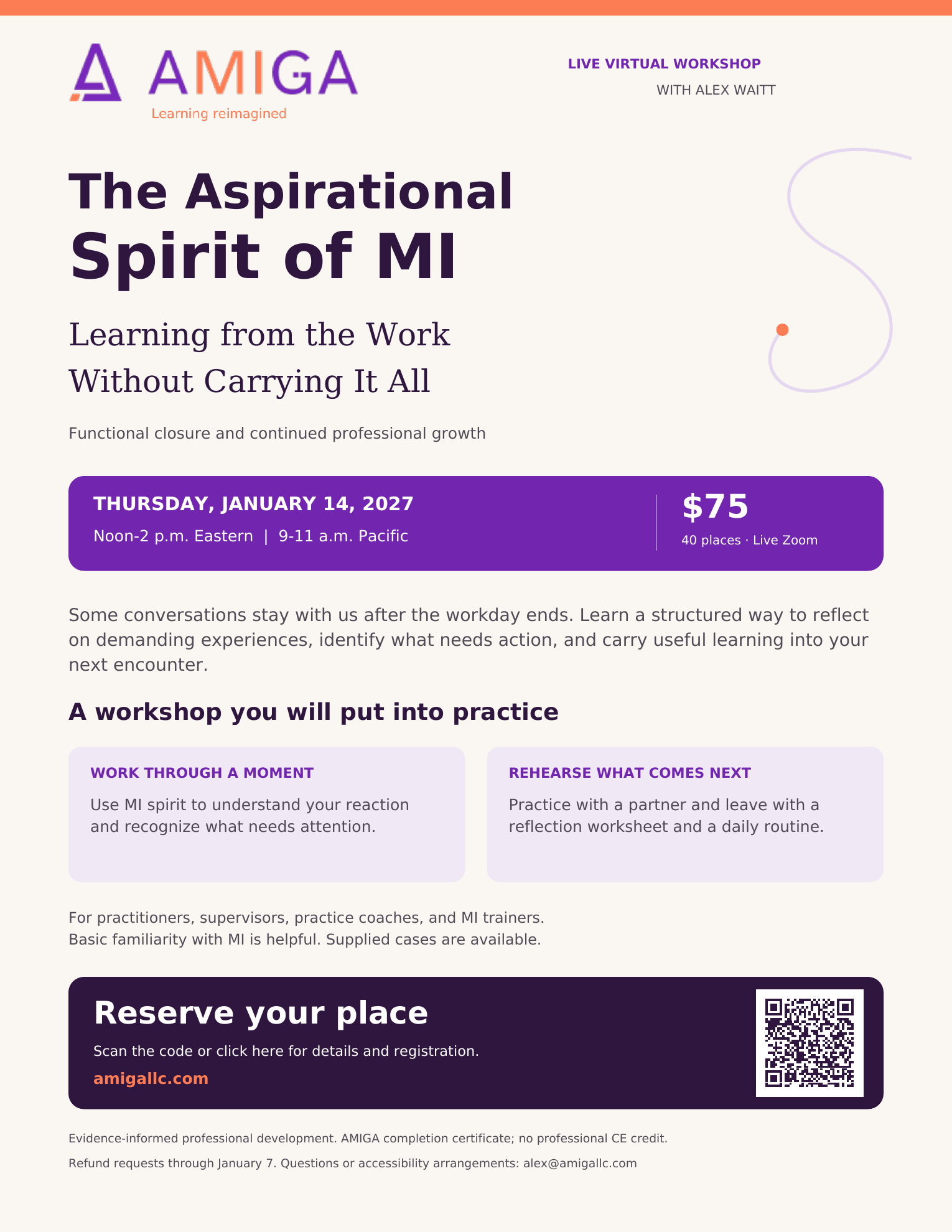
Download the one-page overview to share with a colleague or bring to your supervisor. It includes the workshop focus, date, price, and registration link.
Download the workshop flyer (PDF)
The PDF opens in a new tab. View the flyer as an image.
Plan for your participation
Taking part on Zoom
Use a computer with a microphone and a reliable connection for paired practice. Captions are available. Personal reflection and breakout conversations will not be recorded.
To discuss access or participation accommodations, contact alex@amigallc.com.
Cancellations and substitutions
Refund requests are accepted through January 7, 2027. Attendee substitutions are accepted. If AMIGA cancels the workshop, registered participants receive a full refund.
For substitutions, refunds, or registration questions, contact alex@amigallc.com.
Another January learning opportunity
Explore When Helping Gets Stuck: Adaptive Motivational Interviewing Foundations on January 28. That four-hour workshop focuses on Ask–Offer–Ask and the six conditions for trust and accountability. Each workshop stands alone.