

OUR SOLUTIONS
Find the support your work needs.
Build on your team’s experience with training and practical support across leadership, systems, supervision, and Adaptive Motivational Interviewing. Start with the need you can name.



WHERE TO BEGIN
Choose the support that fits the work.
You can begin in one area. The four services are connected, and none is a required purchase stage.

01
Leadership
People understand the overall vision but are unsure how it should guide their priorities and decisions.

02
Systems
The organization’s values and its routines send different messages about what matters.

03
Supervision
Supervisors are solving recurring problems while struggling to help others build their own judgment.

04
Adaptive MI
A conversation gets stuck, and it is hard to know whether the next step calls for clarity, understanding, or exploring change.
CONNECTED SUPPORT
Start in one area. Connect the support around it.
Training can focus on the conversations your team wants to handle more purposefully. Leadership, systems, supervision, or coaching may help reinforce that learning where relevant.
LEADERSHIP · DIRECTION
Make your leadership easier to understand and act on.
People are unsure what they can count on, how decisions should be made, or who holds responsibility.
- Who it serves
- Leaders and leadership teams.
- What we work through
- Turn leadership commitments into observable expectations: how decisions are explained, concerns are heard, support is provided, and responsibilities are followed through.
- What we aim to strengthen
- Clearer leadership commitments and shared understanding of expectations, decision authority, and accountability.
We agree the focus, format, and any specific deliverables with you.
LEADERSHIP PHILOSOPHY
Commitments people can experience
- In decisions: explain the standard, the reasoning, and what remains open.
- In support: clarify the time, resources, and authority people need.
- In follow-through: do what you said you would do, and address the gaps.
A leadership philosophy becomes useful when people can recognize it in everyday work.
SYSTEMS · DESIGN
Turn shared commitments into usable standards.
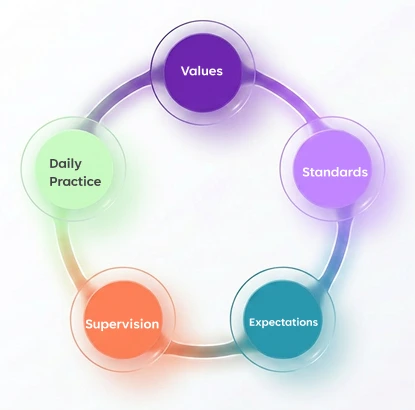
Values are clear in principle, but expectations and routines vary in practice.
- Who it serves
- Leaders, managers, and people responsible for workforce or organizational development.
- What we work through
- Examine how standards, role expectations, competencies, and routines support the work, and identify where they send conflicting messages.
- What we aim to strengthen
- More usable expectations and routines, with a clearer connection between stated values and everyday practice.
We agree the focus, format, and any specific deliverables with you.

SUPERVISION · DEVELOPMENT
Help people think through the work.
Supervisors want to support judgment, give useful feedback, and maintain appropriate responsibility.
- Who it serves
- Supervisors and those developing supervisors.
- What we work through
- Practice exploring a worker’s reasoning, sharing feedback, checking how it is understood, and agreeing on a next step.
- What we aim to strengthen
- Developmental conversations that help people interpret feedback and decide what to try, with appropriate support and consultation.
We agree the focus, format, and any specific deliverables with you.
ADAPTIVE MI · DIALOGUE
Use MI purposefully in the situations your team faces.
Connect MI learning with conversations involving uncertainty, competing priorities, requirements, or ambivalence.
Motivational interviewing is collaborative work that explores a person’s own reasons for change. Sometimes the immediate need is clarity, a boundary, practical support, or understanding before a conversation about change.
- Who it serves
- Practitioners and teams, beginning with their existing MI experience.
- What we work through
- Examine relevant situations, clarify role and purpose, practice responses, and use feedback to reflect on their likely effects.
- What we aim to strengthen
- Stronger judgment and more purposeful application in recognizable conversations.
We agree the focus, format, and any specific deliverables with you.

BUILD ON YOUR EXPERIENCE
Already trained in MI?
Your team’s existing knowledge is part of the starting point. We can discuss the conversations that remain difficult and where additional practice, feedback, or support would be useful.
What participants work through
- Understand the situation, your role, and what you are working toward.
- Examine what you have observed and the assumptions you are adding.
- Consider what the moment needs: clarity, understanding, practical support, or exploration of change.
- Practice a response and receive feedback on what it may make possible.
- Interpret that feedback and choose what to try next.
We use relevant situations so participants can connect practice with their responsibilities and the people they work with. Feedback supports reflection; choosing a response in an exercise does not establish MI proficiency.
Explore examples across our four settings
“Although our staff has had many trainings in Motivational Interviewing (MI) and we do a decent job in engaging our client families, I feel we all took new things away that we can put into practice allowing us to do MI even better.”
Planning training around your team
We’ve already had MI training. Is this relevant?
Your team’s existing knowledge is part of the starting point. We can discuss the conversations that remain difficult and where additional practice, feedback, or support would be useful.
Can we begin with training?
Yes. We can begin with a focused training need and consider what support would help your team apply it. New to MI? We can discuss a suitable foundation.
How would this fit our staffing needs?
We can discuss the audience, coverage, protected learning time, budget, and opportunities for practice after training. The scope and schedule are agreed with you.
CONTINUED APPLICATION
Bring the learning into practice.
Reflect on what happened, what influenced your response, and what you would try next. We can discuss field coaching alongside your team’s training and support needs.
Coaching, supervision, and continued practice may reinforce learning where they fit the agreed engagement. We discuss the arrangements with you; there is no single required coaching format.
FOUR CUSTOMER SETTINGS
Recognize your work in the conversation.
Child welfare, criminal justice, community mental health, and federally qualified health centers (FQHCs) each bring distinct responsibilities and constraints.

Child welfare
Connect leadership, supervision, and family conversations around safety, permanency, and well-being.
When a family and a worker understand “safe” differently, how do you make expectations clear and invite meaningful participation?
Photo: Marcus Lenk / Unsplash. Illustrative setting.

Criminal justice
Make requirements and available choices clear while strengthening conversations about responsibility and change.
When a person disagrees with a requirement, what is fixed—and what can you meaningfully work through together?
Photo: Nhan Hoang / Unsplash. Illustrative setting.

Community mental health
Connect person-centered conversations with the supervision and conditions that help teams use them.
When the treatment goal and the person’s immediate concern differ, how do you understand both and agree on a useful next step?
Explore community mental health
Photo: Angelo Pantazis / Unsplash. Illustrative setting.

FQHCs
Bring patient priorities, team coordination, and practical barriers into everyday care conversations.
When a recommendation does not fit someone’s work, cost, or family circumstances, what needs attention first?
Photo: Brian Wangenheim / Unsplash. Illustrative setting.
These illustrative situations show possible areas of fit. They do not describe named clients or promise outcomes.
Our work with county teams
- Centre CountyCurrent client
- Beaver CountyCurrent client
- Sullivan CountyPrevious client
A USEFUL STARTING POINT
Tell us what your team is working through.
A brief description is enough to begin. We can talk through the audience, existing experience, practical constraints, and useful support.